Energy Vampires: Is Your Romance Getting Your Leftovers?
Energy Vampires: Is Your Romance Getting Your Leftovers?
Your romance called. It’s tired of getting your leftovers.
You’ve spent the day answering messages, solving problems, soothing someone’s latest crisis, and accepting one more responsibility. By the time you settle onto the couch with your partner, you’re ready for everyone—including the person you love—to stop needing you.
If that sounds familiar, ask yourself: Who gets the best of my energy, and who gets whatever remains?
Think of your energy like a luxury item. Be intentional about where you invest it. Someone wanting access doesn’t automatically mean you have the capacity to give it.
When I talk about energy vampires, I mean recurring relationship patterns where someone keeps drawing on your attention, care, and effort while leaving little room for your needs. Before giving more, consider whether that pattern is taking up space you want to reserve for yourself and your romance.
Understanding Relationship Energy and Stress Spillover
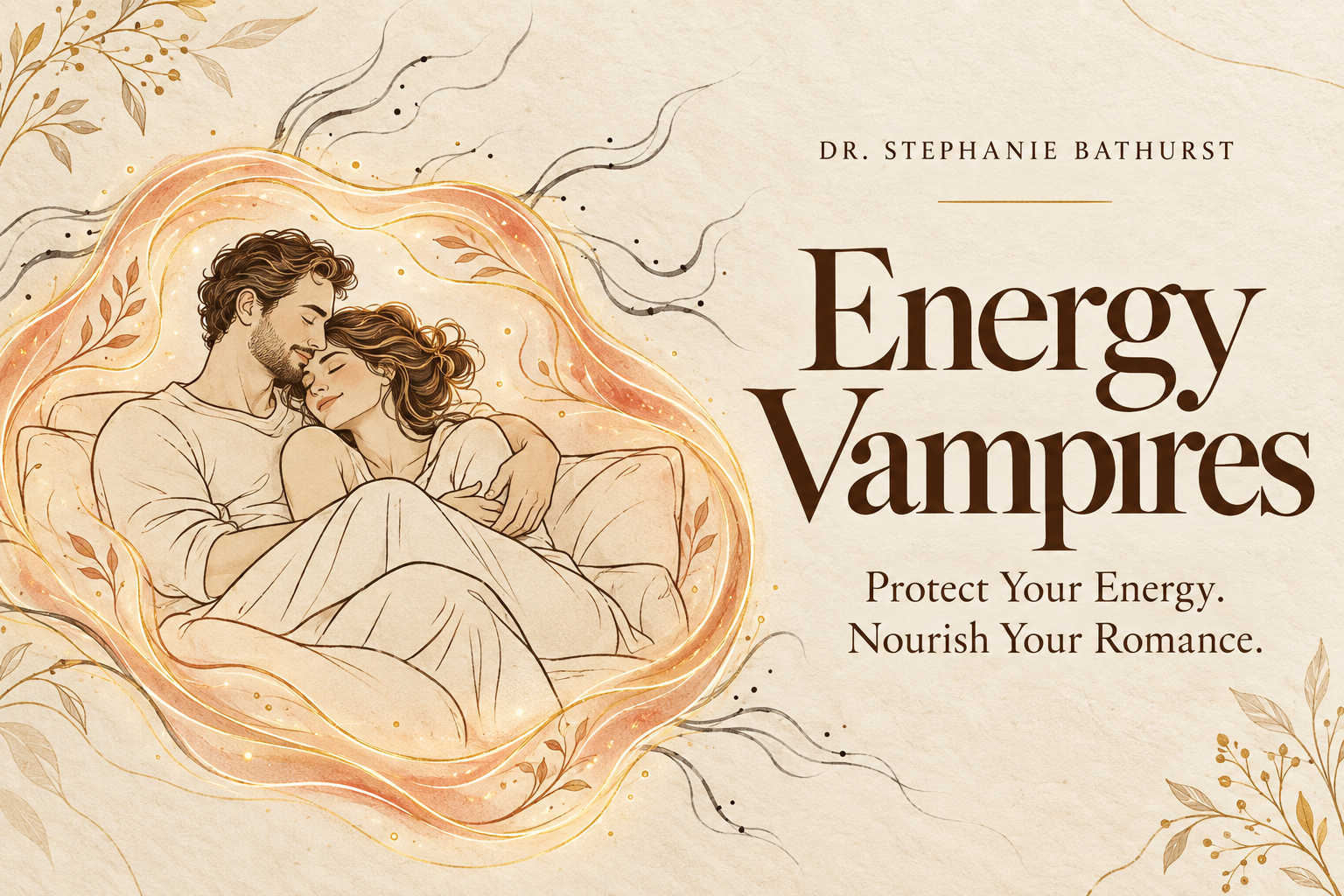
In my Flow Relationship Energy Theory™, I describe relationships as living energetic systems that need ongoing investment. Here, “energy” is a way to reflect on your attention, emotional availability, effort, and capacity for connection.
Consider your relationships beyond romance: friendships, family connections, work, and community. Where do you feel supported? Where do you keep giving beyond what you can comfortably offer? Which commitments reflect the life you want to build?
If you’re unsure where to begin, my free Flow Relationship Energy Quiz offers a starting point for exploring how you give and receive energy in relationships.
Research also suggests that outside stress can affect romantic relationships. In a daily diary study of newlywed couples, participants reported more negative behavior toward their partner and less positive relationship appraisals on days when their stress was higher than usual. This is an example of stress spillover.
That finding doesn’t mean every draining interaction will damage your romance. It does offer a reason to notice what you bring home—and to talk about it rather than assuming your partner is the source of everything you feel.
Signs Someone May Be Emotionally Draining You
“Energy vampire” is a vivid metaphor, not a diagnosis. Use it to recognize a pattern rather than reduce a person to a label.
If you’re asking what the signs of an energy vampire are or how to tell whether someone is emotionally draining you, look for situations in which:
- Every conversation becomes their crisis. Your experiences rarely get space.
- Your “no” earns a guilt trip. They keep pushing after you’ve explained your limit.
- You’re expected to take over. Their problem becomes your assignment without your agreement.
- The same request keeps returning. They repeatedly ask for help with the same thing but refuse to develop the skills to handle it themselves, despite having the capacity and opportunity.
- Support travels mostly one way. They seek your care but rarely show curiosity about what you need.
- You feel responsible for their emotions. You leave conversations believing it is your job to keep them calm, happy, or stable.
- You feel depleted after contact. You regularly need recovery time after interacting with them, especially when the relationship offers little mutual support.
Repeated help alone isn’t the problem. Disability, illness, grief, caregiving, and unfamiliar tasks can require sustained support. The important question is whether the arrangement respects both people’s needs and abilities.
You don’t need perfectly equal effort every day. You do need room to be a person with needs of your own.
Caring Without Taking Over Someone Else’s Life
You can love someone and still let them make the appointment, practice the skill, or decide their next step.
Before volunteering yourself as the unpaid project manager of someone else’s life, pause and ask:
- Do I have the capacity to offer this today?
- Did I agree to this responsibility, or did I automatically absorb it?
- Am I supporting their effort, or doing everything for them again?
- What will I have to give up to say yes?
That last question matters. Perhaps another hour on the phone means missing the walk you planned with your partner. Perhaps accepting another task means sacrificing the quiet time you wanted for yourself.
Name the tradeoff before you commit. Your time deserves a conscious decision.
Practical Boundaries for Emotionally Draining Relationships
If you’re searching for what to say to an energy vampire or how to set boundaries without feeling guilty, remember that a boundary can be warm, direct, and specific:
“I care about you. I can listen for fifteen minutes, but I can’t take this on tonight.”
“I’ve shown you how to do this. Please try the steps yourself first, and let me know where you get stuck.”
“Tonight is time with my partner. I’ll respond tomorrow.”
“I’m able to help with this part. The rest needs to stay with you.”
Choose a limit you can follow through on. If you say you’re unavailable for the evening, put your phone away instead of continuing to negotiate through messages.
A boundary is not a punishment or a demand that someone agree with your limit. It is a clear statement about what you will and will not participate in. If someone repeatedly ignores your boundaries, consider reducing contact, changing the structure of the relationship, or seeking support from a qualified professional.
Reclaim Your Energy for Your Romance
Once you create space, decide how you want to use it. Start with something small enough to feel inviting rather than becoming another obligation.
Snuggle on the couch. Share something funny. Take a short walk. Ask, “What would feel good for us tonight?” Let the answer include rest.
If you’re already depleted, try:
“I’ve given a lot today, and I’m running low. I want to be close to you. Could we have a quiet cuddle without solving anything?”
You can communicate your capacity and your desire for connection in the same breath.
This applies inside the relationship, too. If your partner routinely dismisses your limits or expects you to carry every emotional responsibility, make that pattern part of the conversation. Protecting romance should include care for both of you.
You might say:
“I want us to feel connected, but I can’t be the only person managing our emotional life. I need us to share that responsibility.”
If conversations about boundaries become unsafe, threatening, or controlling, prioritize your safety and seek confidential support from a trusted person or qualified professional.
If you recognize this pattern but feel stuck on how to change it, we can explore your boundaries, communication, and connection together in private relationship therapy or coaching. For partners who want dedicated time away from everyday demands, my Couples Intimacy Retreats bring focused relationship work and shared experiences into the same space.
A Simple Energy Audit for the Week Ahead
Start by identifying one energy-vampire pattern: a recurring demand that leaves you depleted. Write down what it asks of you, what you can realistically offer, and one boundary you’re willing to practice.
Then choose one place to reinvest that space: a playful moment with your partner, a meaningful conversation, or time to restore yourself.
Want to make intentional connection part of your week? Explore my Relationship Planner for Couples on Amazon. As you plan the days ahead, choose one moment for connection and one boundary that will help you protect that time. Give your relationship a place in your plans before the week fills up with everyone else’s needs.
The question I want you to carry into your week is:
Does where I give my energy reflect what I value most?
You can be generous without being endlessly available. Give the people and experiences you cherish a deliberate place in your life—including yourself.
Take my free Flow Relationship Energy Quiz to explore your patterns and choose where you want to invest your energy next.
About Dr. Stephanie Bathurst

Dr. Stephanie Bathurst, PhD, LMFT, is a board-certified Clinical Sexologist, licensed relationship therapist, and founder of Bathurst Couples & Sex Therapy. Based on Oʻahu, she created Flow Relationship Energy Theory™ to explore patterns of giving, receiving, and connection across romantic, familial, and platonic relationships. Her work combines evidence-based therapy with an integrative approach to intimacy, communication, and relationship well-being.