What if my partner refuses to go to therapy?
What if my partner refuses to go to therapy?
You know your relationship needs support. You’ve read the books, listened to the podcasts, tried changing how you communicate, and maybe even researched therapists.
There’s just one problem:
Your partner refuses to go.
This can leave you feeling trapped between two painful options: continue living with a relationship dynamic that isn’t working, or consider leaving someone you may still deeply love.
But resistance to therapy doesn’t always mean your partner doesn’t care about the relationship.
Before deciding what their “no” means, I encourage couples to get curious about what is underneath it.

First, Find Out What They’re Actually Resisting
Instead of repeatedly trying to convince your partner that they need therapy, sit down when you’re both regulated and approach the conversation with curiosity.
Try:
“I know you’ve been hesitant about getting outside support. I don’t want to pressure you. I do want to understand what makes it feel uncomfortable or unhelpful to you.”
Then listen.
Their resistance may have very little to do with how much they love you.
Have they had a bad experience with therapy before?
A previous therapist may have felt judgmental, ineffective, biased, overly clinical, or simply like the wrong personality fit.
If someone walked away from therapy feeling misunderstood or blamed, asking them to return can feel like asking them to repeat an experience they already learned not to trust.
The problem may not be:
“I refuse to work on our relationship.”
It may actually be:
“I don’t trust therapy to help us.”
Those are very different problems.
Are they afraid change will require loss?
Meaningful relationship work disrupts the status quo.
If you begin addressing boundaries, resentment, intimacy, emotional labor, communication, family dynamics, or individual needs, something will probably have to change. Even healthy change can feel threatening when the current pattern is familiar.
Sometimes the discomfort we already know feels safer than the uncertainty of something new.
Do they believe you’ll never actually leave?
Sometimes one partner has been unhappy for years, while the other hasn’t fully understood the seriousness of that unhappiness.
After dozens of conversations followed by little lasting change, an unconscious assumption can develop:
“We always get through it. They aren’t actually going anywhere.”
That belief can decrease urgency. This is why communicating the impact of your current relationship dynamic may be more productive than repeatedly arguing about therapy itself.
Are they afraid of opening Pandora’s box?
For someone carrying unresolved trauma, grief, betrayal, shame, family wounds, or painful memories, therapy may represent something much larger than talking about the relationship.
They may be thinking:
“What happens if I open all of this and can’t put it back?”
Avoidance can function as protection.
Understanding that fear doesn’t mean accepting indefinite avoidance. It gives you better information about the problem you’re actually trying to solve.
Resistance Isn’t the Same as Refusal to Grow
Neither you nor your partner needs to perfectly embody every characteristic of a healthy relationship today.
We are all on a growth journey.
A more useful question is:
Do you see continuous progress and genuine effort—even if it’s happening in small steps?
Maybe your partner isn’t ready for couples therapy, but they’re communicating more openly.
Maybe they agreed to learn something with you.
Maybe they’re becoming more accountable after conflict.
Maybe they’re respecting a boundary they previously struggled with.
Maybe you’re both catching unhealthy patterns sooner.
Those changes matter. If there is genuine effort and movement, practice patience where you can and celebrate the little wins.
The greater concern is when resistance to therapy is part of a broader resistance to any form of accountability, curiosity, repair, learning, or change.
Therapy Isn’t the Only Way to Begin
A common mistake is assuming there are only two choices:
Weekly couples therapy—or nothing.
There is actually a spectrum of support, and the best starting point depends on your priority, your partner’s current level of willingness, and how deeply entrenched your relationship patterns have become.
Option 1: Dip Your Toes In With Shared DIY Growth
If your partner’s response is, “I don't want to go to therapy,” try finding out whether they would be open to learning together without immediately entering a clinical environment.
This can be a much lower-pressure entry point.
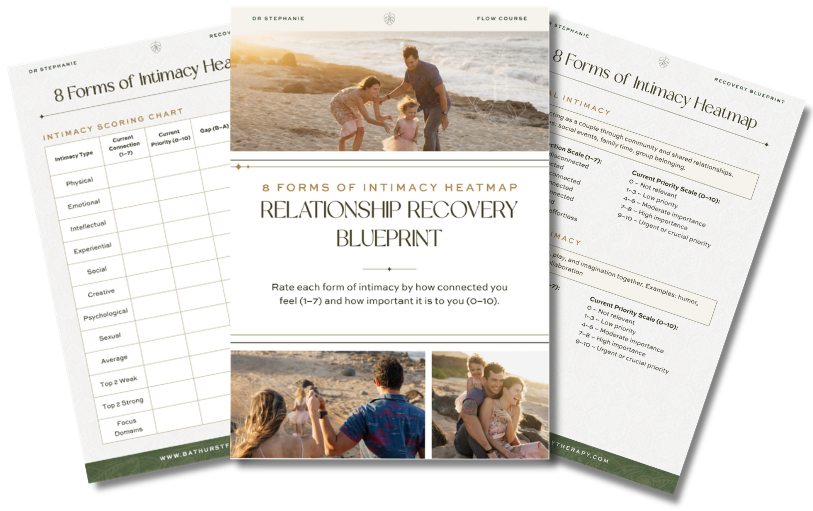
My 28-Day Roommates to Romance program is a DIY relationship-growth experience couples can complete together at home. It combines evidence-based relationship psychology with my proprietary Flow Relationship Energy Theory™ and The 8 Forms of Intimacy™.
Instead of framing it as “we need therapy,” you can approach it as:
“Would you be willing to spend a month learning more about each other with me?”
For some couples, getting curious together is a far easier first step than walking into a therapist’s office.
Option 2: Begin With Your Own Individual Growth
Your partner does not have to participate for you to begin changing the way you experience and respond to your relationship.
Individual support can help you explore your boundaries, attachment patterns, resentment, emotional triggers, communication habits, relationship expectations, self-trust, and decisions about what you are—and are not—willing to continue accepting.
Changing one part of a relational system can influence the way the entire system functions.
It also gives you somewhere productive to put your energy when you cannot control whether your partner participates.
Option 3: Focused Private Sessions
Sometimes the resistance isn’t to getting help—it’s to the idea of spending months or years in traditional weekly therapy.
For couples or individuals who want focused professional support, I offer private sessions, with many structured as longer-duration sessions.
Why?
Because I want enough uninterrupted time to identify the pattern, build momentum, and actually work with it rather than ending the conversation every time we finally make meaningful progress.
This format can be useful when the priority is focused work around communication, resentment, trust, emotional intimacy, seggsual connection, trauma patterns, or another clearly defined concern.
Option 4: Support the Individual Growth That Affects Your Relationship
Sometimes the relationship is being affected by something one or both partners need to explore more deeply as individuals.
Personal growth work can complement—not replace—appropriate relationship or mental-health care.
1, For couples interested in self-directed growth, some of the outside programs I personally recommend include:
Dr. Neha Sangwan’s
Healing Burnout program through Mindvalley
This may be worth exploring when chronic stress, depletion, or burnout is affecting how much emotional energy someone has available for connection.
2. For individuals wanting to explore sensuality and their relationship with themselves:
Rachel Pringle’s
Wild Woman Sensuality program through Mindvalley
3. And for those interested in exploring intimacy and tantra:
Layla Martin’s
Neo-Tantra program through Mindvalley
Some resources linked in this article are affiliate links, which means I may receive compensation if you purchase through them, at no additional cost to you. I only include resources that are relevant to the topic and that I believe may complement your growth.
Or Take a Nosedive Into Transformation
Sometimes couples don’t need another worksheet.
They need to get out of the environment where the same relational responses have been rehearsed hundreds or thousands of times.
Your brain and body learn through repetition and association. Certain environments, routines, conversations, and even rooms in your home can become cues for familiar emotional and behavioral responses.
That is part of what makes immersive relationship retreat so different.
Option 5: Immersive Couples Intimacy Retreats
Retreats create concentrated time and a different environment in which couples can interrupt familiar patterns, practice new responses, experience connection differently, and build momentum before returning home.
Rather than spending an hour doing meaningful work and immediately returning to the routines associated with your existing relationship patterns, immersion gives us time to stay with the process.
For couples ready for that deeper experience, there are two pathways:
1. Radiant Retreats — Group Experiences in California + Hawaiʻi
For couples who want immersion while also benefiting from the energy and shared experience of other couples committed to their growth, Radiant Retreats offers intimate group experiences in California and Hawaiʻi.
These are designed for couples who want concentrated relationship growth, experiential intimacy work, and the opportunity to reconnect away from everyday responsibilities.
2. Private 5–7 Day Couples Intimacy Retreats With Dr. B — Hawaiʻi
For couples who want maximum privacy, personalization, and concentrated attention, I also offer private 5–7 day immersive Couples Intimacy Retreats in Hawaiʻi.
This is the deepest level of support I offer: an experience built around the specific emotional, relational, intimate, and energetic patterns occurring between the two of you.
Instead of adapting yourselves to a group curriculum, the experience can be shaped around your relationship.
Explore
Private Couples Intimacy Retreats in Hawaiʻi
Choose Your Support Based on Your Priority
You don't have to begin with the most intensive option.
Ask yourself: What is our actual priority right now?
If This is You... “My partner isn't ready for therapy, but might learn alongside me.” Then choose: 28-Day Roommates to Romance DIY program
“My partner won't participate yet, but I need clarity and support.” Then choose: Individual private sessions
“We want professional help with a specific relationship pattern but have a happy, healthy foundation.” Then choose: 6 Private sessions bundle (save 15%)
“We want concentrated growth without a private retreat.” Then choose: Radiant Retreats in CA + HI (immersion in small groups for fast results)
“Our patterns are deeply entrenched and we want an immersive reset.” Then choose: Private 5–7 day Couples Intimacy Retreat in Hawaiʻi with Dr. B (for luxury AND rapid transformation with world's top expert)
There is no prize for choosing the most intensive option first.
The most useful intervention is the one that matches your current needs and your genuine willingness to participate.
What if They Still Say No to Everything?
There is an important distinction between:
“I’m scared, skeptical, or not ready for therapy, but I’m willing to work on us.”
and:
“I don’t believe anything needs to change, and I’m unwilling to participate in changing it.”
The first leaves room for curiosity, patience, education, alternative forms of support, and incremental progress.
The second gives you important information about the relationship.
You cannot force another adult to become emotionally available, pursue healing, take accountability, or invest in your relationship.
But you can decide what you do with their answer.
You can get support independently.
You can clarify your needs.
You can establish boundaries.
You can stop carrying 100% of the responsibility for a relationship that requires two participants.
And you can pay attention to whether their actions demonstrate that maintaining and improving your relationship matters to them.
Start With Curiosity, Not an Ultimatum
If your partner refuses therapy, your first conversation doesn't necessarily need to be about convincing them to attend.
Try asking:
“What about getting support feels hardest to you?”
Then get curious about the answer.
Because sometimes underneath “I don't want therapy” is fear.
Sometimes it's mistrust, shame, overwhelm.
Sometimes it's a lack of urgency.
And sometimes it truly is an unwillingness to change.
You need to understand which one you're dealing with before you can make an informed decision about what comes next.
Your partner doesn't have to be perfectly healed to be a good partner. Neither do you.
Look for willingness. Look for accountability. Look for effort. Look for small changes that eventually become consistent changes.
And when those little wins appear, celebrate them.
Healthy relationships aren't created by two people who have finished growing.
They're created by two people who are willing to keep growing together.
Dr. B
10× Global Award-Winning Relationship Therapist, Clinical Sexologist & Intimacy Architect™
Helping individuals and couples repattern trauma, restore trust, and reawaken intimacy through Flow Relationship Energy™ + the 8 Forms of Intimacy™.